
Enigmatic and influential figures in world history
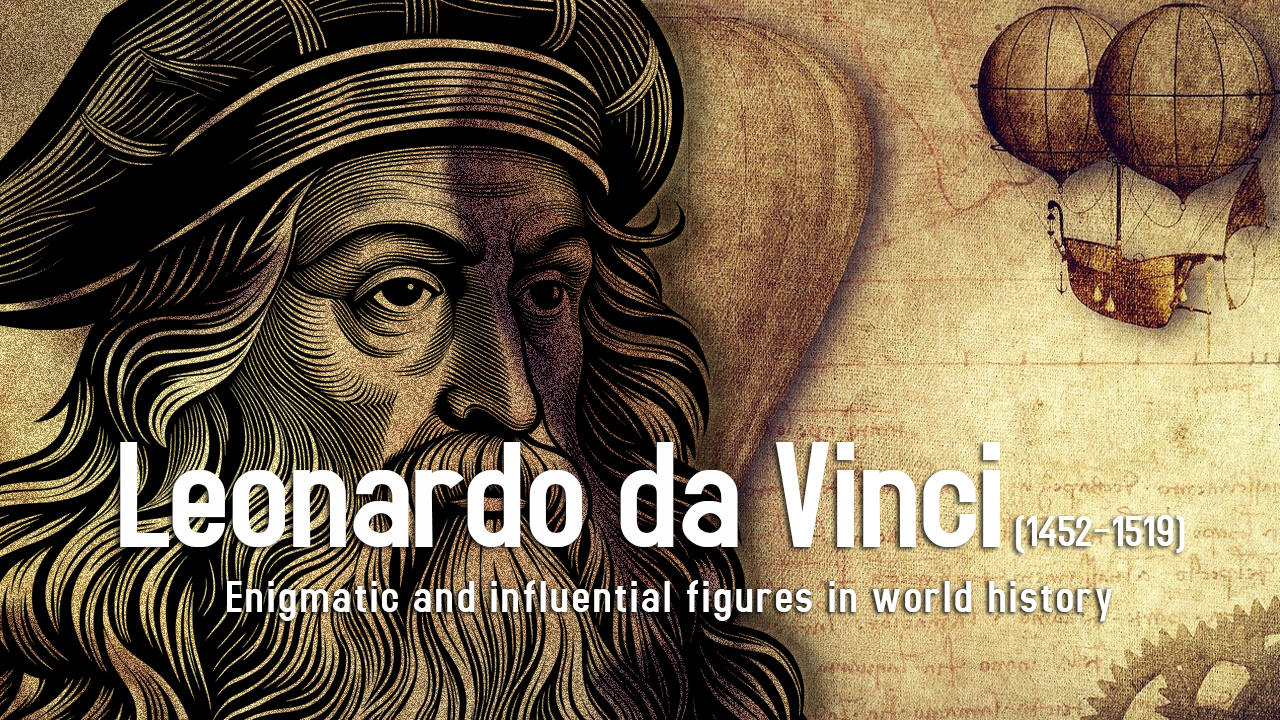
Leonardo da Vinci (1452–1519) stands as one of the most enigmatic and influential figures in world history, celebrated not only for his artistic genius but also for his pioneering contributions to science, engineering, and anatomy. Born in Vinci, a town in Tuscany, to a family of artists, Leonardo was immersed in the traditions of Renaissance humanism from an early age. His father, a notary and painter, nurtured his curiosity, though Leonardo’s own pursuits often straddled the line between art and science, creating a unique legacy that transcends disciplinary boundaries. Unlike many of his contemporaries, who focused solely on aesthetics, Leonardo sought to unify the principles of nature, anatomy, and mechanics through meticulous study and experimentation.
Leonardo’s polymathic nature is epitomized by his vast intellectual pursuits. He is credited with inventing numerous devices that laid the groundwork for modern engineering, including the flying machine, hydraulic machines, and anatomical instruments. His notebooks, filled with sketches and calculations, reveal a mind obsessed with understanding the mechanics of the human body, the flight of birds, and the flow of water. His anatomical studies, such as the Vitruvian Man and detailed dissections, demonstrated a profound curiosity about human physiology, blending artistic skill with scientific rigor. Similarly, his engineering feats—like the design of a mechanical arm and a self-propelled armored tank—highlight his visionary approach to problem-solving. These innovations, though many were unrealized during his lifetime, underscore his role as a precursor to modern scientific methods.
Leonardo’s artistic legacy is equally monumental. His paintings, such as The Last Supper and Mona Lisa, are celebrated for their technical mastery and emotional depth. His technique of sfumato, which created soft transitions between light and shadow, and his use of linear perspective revolutionized European art. Yet, his true genius lies in his ability to integrate art with science. He viewed art as a means to explore natural truths, believing that the observer’s perception of reality was shaped by the interplay of light, anatomy, and proportion. This philosophy is evident in works like The Annunciation, where anatomical accuracy and symbolic meaning coexist. His notebooks, a treasure trove of ideas, reveal a mind that saw no distinction between art and science, treating them as facets of a single, unified pursuit of knowledge.
Leonardo’s influence extended beyond his lifetime through the cultural and intellectual currents of the Renaissance. His works inspired generations of artists and thinkers, and his methodologies laid the groundwork for the scientific revolution. Today, his legacy endures not only in the places where his art is housed but also in the interdisciplinary spirit he championed. His notebooks, preserved in institutions worldwide, continue to spark debates about the nature of creativity and inquiry. Ultimately, Leonardo da Vinci remains a symbol of the Renaissance ideal—where art, science, and humanism converged to create something that still resonates across centuries. His life serves as a reminder that true innovation often lies at the intersection of disciplines, where the pursuit of knowledge is both a personal endeavor and a collective human achievement.